


Can DNA Testing Really Find Your African Tribe?
June 4, 2026
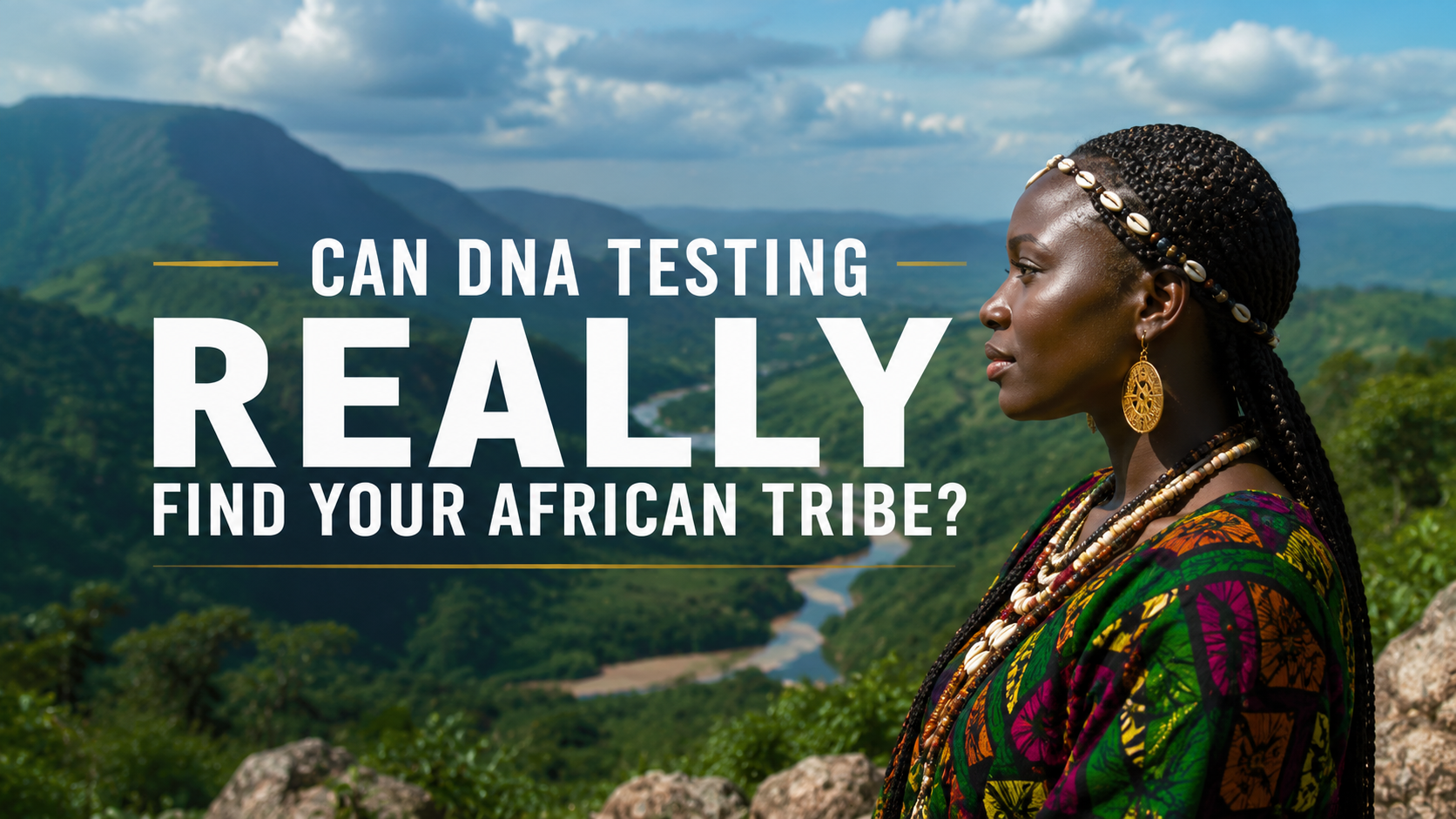
One of the most common questions people ask after taking a DNA test is:
“Can DNA testing actually tell me my African tribe?”
The answer is more nuanced — and more powerful — than many people realize.
The internet is filled with oversimplified claims about DNA and tribal identity. Some companies market ancestry results as if DNA alone can perfectly identify a tribe with absolute certainty. Others dismiss the idea entirely and claim tribal identification is impossible.
The truth lives somewhere in the middle.
At Tribal Tapestry, we believe people deserve a deeper and more honest conversation about what DNA can — and cannot — reveal.
The First Misconception: Ethnicity and Tribe Are Not Always the Same
Many people use the words “ethnicity,” “nation,” “culture,” and “tribe” interchangeably.
But historically, Africa has always been far more complex.
For example:
- Yoruba is both an ethnic identity and a civilization containing multiple kingdoms and lineages.
- Igbo identity contains many regional and clan distinctions.
- Fulani populations stretch across multiple countries.
- Some tribal systems overlap geographically.
- Colonial borders divided many African peoples artificially.
This means DNA testing does not work like a magical barcode scanner that says:
“You are exactly 73% from one single village.”
Human history is more layered than that.
DNA is about genetic patterns, migration history, population similarity, and ancestral probability.
But that does not make it meaningless.
In fact, it can still be incredibly revealing.
DNA Can Reveal Powerful Ancestral Clues
Modern ancestry testing can often identify:
- regions of origin
- population similarities
- ethnic clusters
- migration patterns
- shared ancestry with present-day populations
- living DNA relatives
For African Americans whose ancestral records were erased through slavery, this can become life-changing.
Imagine discovering:
- strong Yoruba ancestry from southwestern Nigeria
- Igbo ancestry connected to southeastern Nigeria
- Mende ancestry linked to Sierra Leone
- Akan ancestry tied to Ghana
- Fulani ancestry stretching across West Africa
These are not random labels.
They are windows into history, culture, language, spirituality, food, music, naming traditions, kingdoms, and identity systems that existed long before slavery.
For many people, DNA becomes the beginning of recovering a story that was interrupted generations ago.
Tribe Is More Than Genetics
This is where many DNA companies stop too early.
DNA alone does not fully restore identity.
Culture matters too.
A tribe is not merely a genetic category.
It is also:
- language
- oral history
- worldview
- philosophy
- family systems
- spirituality
- customs
- historical memory
- land connection
- community recognition
This is why Tribal Tapestry approaches ancestry differently.
We believe reconnection should go beyond percentages on a screen.
A DNA result should open a doorway into deeper understanding.
Tribal Tapestry’s Difference
Most DNA companies focus almost entirely on raw percentages.
At Tribal Tapestry, we focus on interpretation, reconnection, and cultural meaning.
That means helping people understand:
- the historical significance of their ancestry
- where tribes migrated from
- how kingdoms developed
- cultural traditions connected to those groups
- the modern-day locations of their ancestral peoples
- possible living-relative connections
- pathways toward travel, cultural immersion, and reconnection
For many clients, the emotional impact is profound.
Some people discover for the first time that their ancestry is not abstract.
It is alive.
Real people.
Real cultures.
Real places.
Real lineages.
DNA Is a Starting Point — Not the End of the Journey
Some critics ask:
“Can DNA testing perfectly prove your exact tribe?”
That question misunderstands the purpose entirely.
DNA is not meant to replace culture, elders, oral history, or lived experience.
It is a bridge.
A bridge back toward:
- identity
- understanding
- ancestry
- homeland
- family
- belonging
And for descendants of slavery, even recovering part of that bridge can be deeply meaningful.
Because for centuries, many African Americans were told their specific origins were lost forever.
Today, science, history, and African cultural knowledge are beginning to reconnect those pathways.
The Future of African Reconnection
As DNA databases grow across Africa, tribal identification and relative matching will likely become increasingly sophisticated over time.
The future may include:
- stronger regional precision
- expanded African DNA reference panels
- living-relative matching
- deeper clan and lineage analysis
- integration of oral histories and cultural records
- African-centered interpretation systems
At Tribal Tapestry, we believe the future of DNA is not merely entertainment.
It is restoration.
Not just discovering where your ancestors suffered —
but discovering who they were before suffering.
And that changes everything.
Begin Your Journey of Reconnection
Your ancestry may hold far more than percentages.
It may hold the beginning of your return.
Start Your Tribal Tapestry DNA Journey
Order Your Tribal Tapestry DNA Kit