


The X Was Never Meant to Be Permanent
June 17, 2026
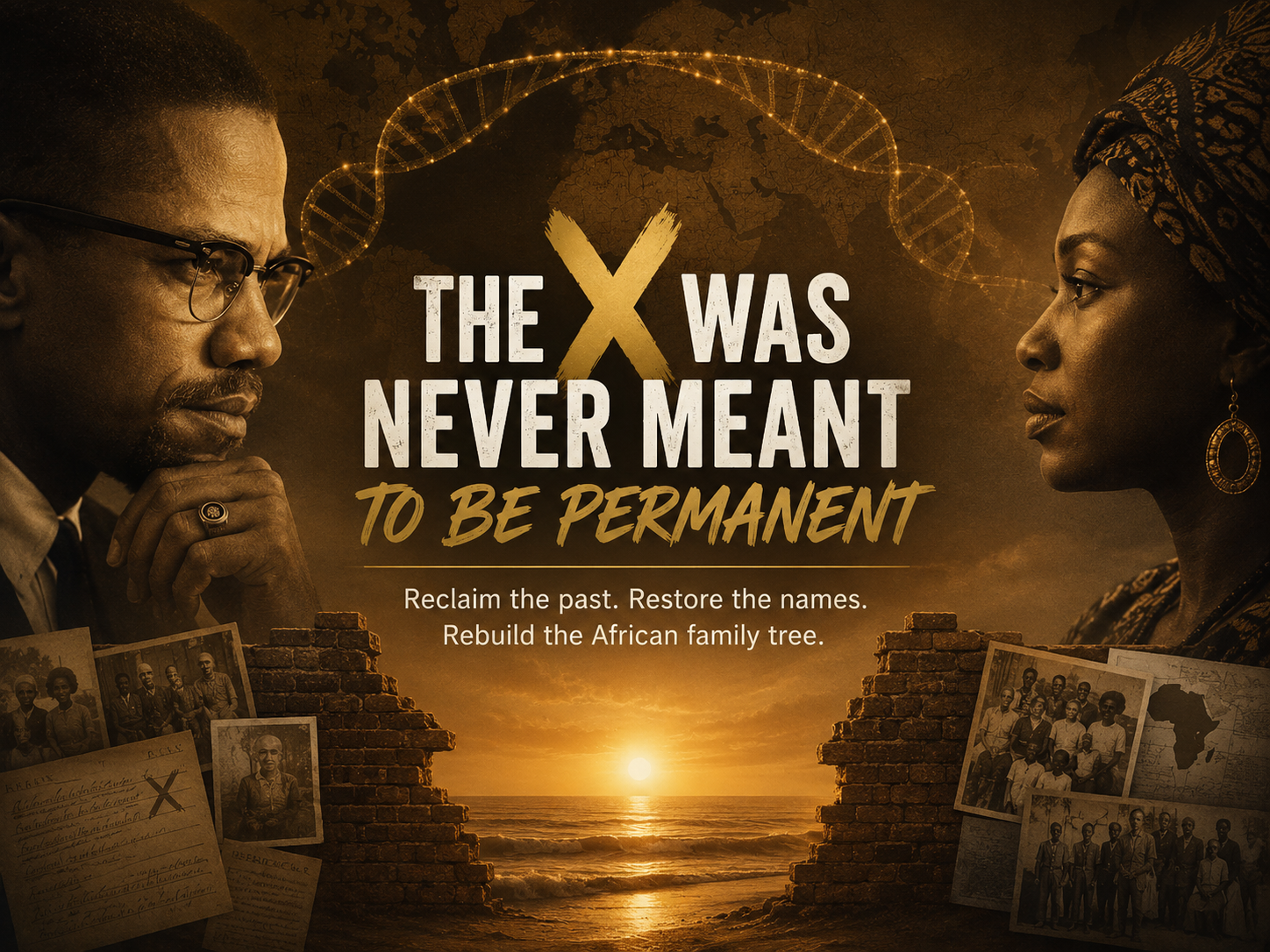
What If Malcolm X Had the Tools We Have Today?
When Malcolm X chose the surname "X," he was making a statement about a problem that millions of African Americans understood.
He knew his family history did not begin with the name Little.
Like many descendants of enslaved Africans, he understood that somewhere between Africa and America, a portion of his family's story had disappeared from view. The X represented that absence. It acknowledged a gap in the historical record and a question that seemed impossible to answer.
Who were his ancestors before slavery?
For much of American history, that question carried more frustration than possibility.
The records were incomplete. Family stories often ended abruptly. Names changed. Generations passed. Entire branches of ancestry disappeared into the fog of history.
Malcolm lived during a period when recovering those answers was extraordinarily difficult. The desire to reconnect with Africa existed, but the tools required to trace specific family connections across centuries and continents simply did not.
That reality shaped how many people thought about ancestry.
The search was meaningful.
The answers often remained out of reach.
A Different Century
It is difficult to overstate how much the world has changed since Malcolm's death in 1965.
At that time, there was no consumer DNA testing.
There were no online genealogy databases.
There were no digital archives containing millions of historical records.
There was no social media connecting families across continents in real time.
Many of the technologies people now take for granted would have seemed unimaginable.
Today, a person can sit at a kitchen table and access records, databases, and family history resources that previous generations could not have reached in a lifetime of research.
That does not mean every mystery can be solved.
Far from it.
The history of slavery created disruptions that no technology can completely erase.
Yet the difference between "impossible" and "difficult" is enormous.
Many questions that once appeared permanently unanswered can now be investigated.
That shift may prove historically significant.
The Search for More Than Geography
When people discuss ancestry, they often focus on location.
Which country?
Which region?
Which tribe?
Those questions matter.
But they are not the deepest questions.
The search for ancestry is ultimately a search for context.
People want to understand how they fit into a larger story.
They want to know where they come from, who came before them, and how their family arrived at the present moment.
This desire is not unique to descendants of Africa.
Families throughout the world preserve names, stories, photographs, traditions, and records because they provide continuity across generations.
They create a sense of belonging.
The tragedy of slavery was not simply that people were transported across an ocean.
It was that millions were separated from the historical continuity that many families take for granted.
That interruption continues to shape the present.
Yet it does not necessarily define the future.
What Remains?
Conversations about slavery often focus, understandably, on loss.
Names were lost.
Languages were lost.
Family connections were broken.
Cultural continuity was disrupted.
These realities cannot be ignored.
But another question deserves attention.
What remains?
Not everything disappeared.
Entire peoples remained.
Entire cultures remained.
Entire nations remained.
Bloodlines remained.
In many cases, relatives remained.
For centuries, the challenge was not that these things no longer existed. The challenge was that reconnecting them to one another was extraordinarily difficult.
That distinction matters.
Because it changes the nature of the conversation.
The story is no longer only about what was taken.
It is also about what can be recovered.
The Opportunity Before Us
Every generation inherits a different set of possibilities.
Previous generations preserved what they could through oral history, family memory, churches, communities, and tradition.
Those efforts matter more than many people realize. Without them, much of what remains today would have been lost entirely.
Our generation has inherited a different responsibility.
For the first time in history, descendants of Africa possess tools capable of helping reconnect fragments of family stories that have been separated for centuries.
Genealogy is advancing.
DNA science continues to evolve.
Historical records are becoming more accessible.
International travel has become dramatically easier.
Communication across continents is instantaneous.
Taken together, these developments are creating opportunities that did not exist during Malcolm's lifetime.
The implications extend beyond family history.
Identity influences belonging.
Belonging influences relationships.
Relationships create opportunities.
The ability to recover ancestral connections may ultimately shape far more than genealogy.
It may influence how people understand themselves, their communities, and their future.
Beyond the X
The enduring power of Malcolm X lies partly in the question he represented.
He understood that something was missing.
He understood that history had interrupted a story.
What he could not have known was how dramatically the tools available to future generations would change.
The question that Malcolm carried has not disappeared.
Millions of people still ask it.
But the context is different now.
The search no longer begins from the assumption that the answers are gone forever.
For the first time, many of those answers may be discoverable.
Not all of them.
Perhaps not even most of them.
But enough to change the conversation.
The X symbolized uncertainty.
Our generation may become the first generation with the ability to replace some of that uncertainty with knowledge.
And if that happens, the significance will extend far beyond genealogy.
It will reshape how descendants of Africa understand identity, inheritance, and the connections that survived even when history suggested they had been lost.