


Living in America, Building in Africa
June 15, 2026
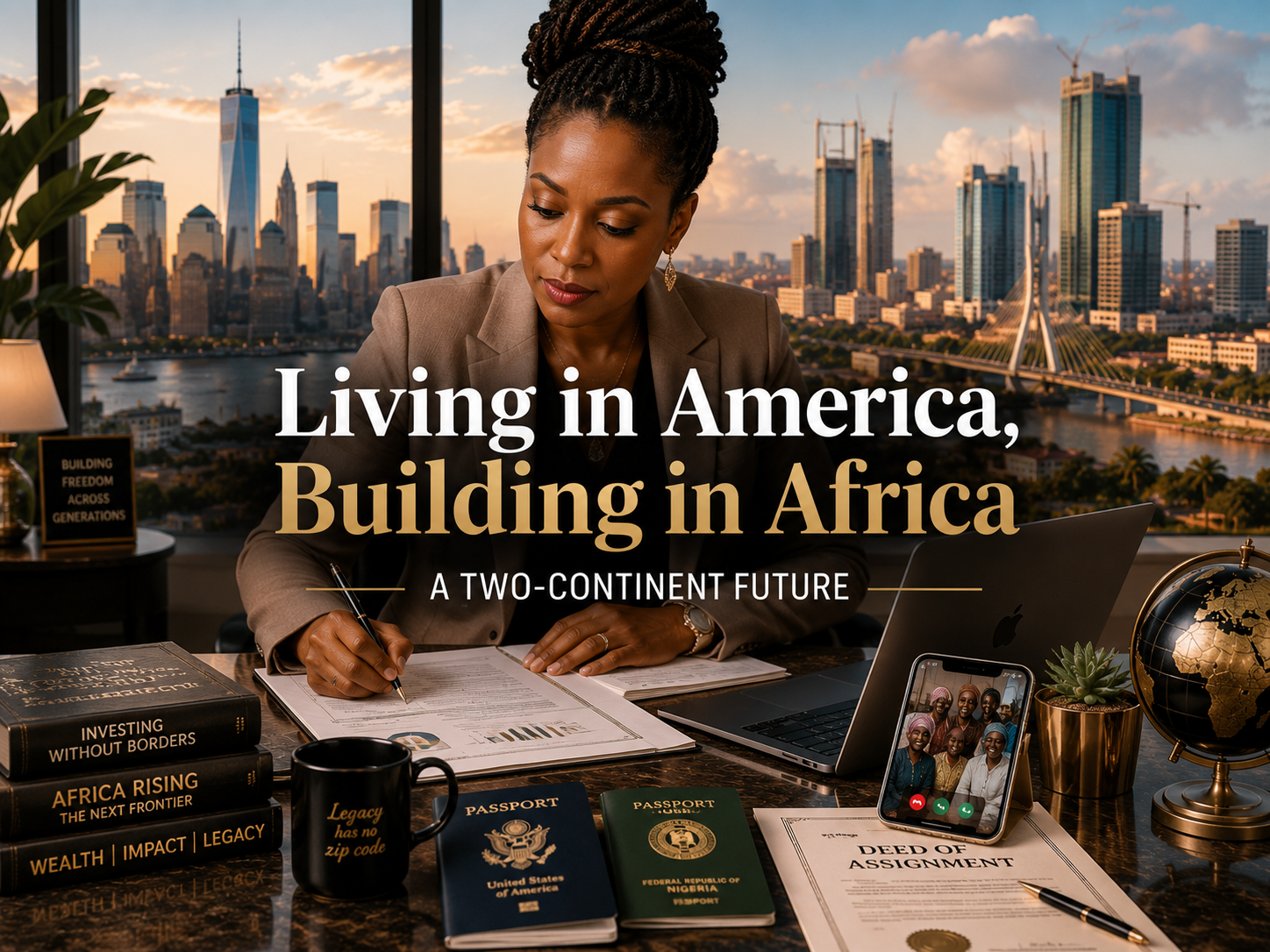
For most of my life, I assumed that everything I would ever build would exist in America.
My career was in America.
My business was in America.
My investments were in America.
My future, as far as I could imagine it, was in America.
Africa belonged to a different category.
It was where my ancestors came from.
It was part of my history.
It was not part of my strategy.
That changed when I began researching my family history.
What started as a search for ancestry eventually became something much larger. DNA testing and genealogy led me to Yoruba ancestry in Nigeria. That journey eventually led me to living relatives. It led me to traditional rulers who knew more about my family history than I did. It led me to my ancestral family compound. It led me to citizenship.
It also forced me to confront a question I had never seriously considered.
Why was I viewing America and Africa as an either-or proposition?
Why couldn't it be both?
The False Choice
Many descendants of Africa unconsciously accept a framework that previous generations inherited.
America is where you live.
Africa is where you came from.
One is practical.
The other is symbolic.
One is about opportunity.
The other is about identity.
The problem is that reality no longer fits that framework.
We live in a world where capital moves globally. Businesses operate internationally. Families are spread across continents. Investors buy assets in countries they have never visited. Remote work allows people to earn income in one place while living in another.
Geography matters less than it once did.
Yet many people still think about their future as though they are limited to a single country.
The question is not whether America matters.
America matters enormously.
The question is whether it makes sense to ignore an entire continent connected to your ancestry while the world becomes increasingly global.
A Different Kind of Return
When many people hear the phrase "returning to Africa," they imagine relocation.
That is not what I am talking about.
Some people may choose to move.
Many will not.
The more interesting possibility is something else entirely.
What if reconnecting to Africa is not about leaving America?
What if it is about expanding your options?
Most people do not think twice about maintaining relationships, investments, or business interests across multiple states.
Increasingly, people maintain those relationships across multiple countries.
The descendants of Africa may be uniquely positioned to do something similar.
Not because of politics.
Not because of ideology.
Because of ancestry.
Because millions of people already have a connection that many others spend years trying to create.
The Wealth of Relationship
One of the biggest lessons I learned from reconnecting with my ancestry is that identity can create access.
Not automatic access.
Not guaranteed access.
But access nonetheless.
When I arrived in Nigeria, I was not treated like a tourist.
I was treated like family.
That distinction matters.
Family relationships create opportunities that do not exist in ordinary transactions.
Families share knowledge.
Families open doors.
Families provide introductions.
Families create trust.
The same principle applies whether you are talking about a family in Chicago, Lagos, Atlanta, London, or Imota.
People often think about ancestry as an emotional benefit.
They rarely think about it as a relationship network.
But relationships have always been one of the most valuable forms of capital in human history.
The conversation changes when identity becomes connection, and connection becomes opportunity.
The Rise of the Two-Continent African
I believe a new identity is beginning to emerge.
Not African.
Not African American.
Not Nigerian American.
Something broader.
The Two-Continent African.
Someone who understands where they live but also understands where they come from.
Someone who sees identity not merely as heritage but as inheritance.
Someone who can build relationships, businesses, investments, and opportunities across multiple continents.
This identity did not exist at scale for previous generations.
The technology wasn't available.
The records weren't available.
The DNA tools weren't available.
The communication infrastructure wasn't available.
Today, all of those barriers are disappearing.
For the first time in centuries, descendants of Africa can discover their ancestral origins, connect with living communities, communicate instantly across continents, travel more easily, and participate in opportunities that previous generations could scarcely imagine.
That changes the equation.
Ownership Changes Perspective
My thinking changed even further after becoming a Nigerian citizen and acquiring land.
Ownership has a way of transforming abstract ideas into practical realities.
Before ownership, a place can feel distant.
After ownership, your perspective changes.
You begin paying attention.
You learn more.
You build relationships.
You become invested in outcomes.
You stop viewing a country as a headline and start viewing it as part of your future.
I believe this is one reason why many conversations about Africa in the diaspora remain incomplete.
Too many people are evaluating the continent as observers.
Very few are evaluating it as participants.
Observers look for reasons something cannot work.
Participants look for ways to make it work.
Those are very different perspectives.
The Opportunity Most People Never Examine
I am not arguing that Africa is perfect.
It is not.
Every country has challenges.
America has challenges.
Europe has challenges.
Africa has challenges.
The more useful question is whether challenges are the only thing worth discussing.
When investors evaluate opportunities, they do not focus exclusively on present conditions.
They look at trajectories.
They look at demographics.
They look at resources.
They look at growth.
They look at long-term potential.
Africa's population is expected to grow substantially during this century.
Its urban centers continue to expand.
Its entrepreneurial ecosystem continues to mature.
Its influence in the global economy continues to increase.
Whether those trends ultimately produce extraordinary outcomes remains to be seen.
But they are trends worth paying attention to.
Especially if your ancestry already connects you to the continent.
A Larger Future
I still live in America.
I still do business in America.
I still believe America offers tremendous opportunities.
Nothing about reconnecting with Africa required me to abandon any of that.
Instead, it expanded my understanding of what was possible.
I no longer see my future through a one-country lens.
I see it through a two-continent lens.
That shift may be one of the most important opportunities available to descendants of Africa in the twenty-first century.
Not because everyone should move.
Not because everyone should invest.
Not because everyone should become a citizen.
But because everyone deserves to know that those options exist.
For generations, much of the conversation focused on what was taken from us.
That conversation matters.
But another question deserves attention as well.
What remains?
In my case, what remained was ancestry.
What remained was family.
What remained was belonging.
What remained was citizenship.
What remained was opportunity.
The more I explored those possibilities, the more I realized something important.
Africa was never just part of my past.
It could also be part of my future.
Related Reading
- The Africa Advantage: Why the Future of Black Wealth May Be Global
- The New African American Dream: Building Wealth on Two Continents
- What If Africa Is the Missing Piece of the Black Wealth Conversation?
- Black Privilege: The Untapped Advantage Hidden in Plain Sight
- The Story of Jon James Omobowale Olomo: From Discovery to Citizenship
Jon James Omobowale Olomo is the founder of Tribal Tapestry. After discovering his Yoruba ancestry through DNA and genealogy, he located living relatives in Nigeria, stood on his ancestral family compound, received formal recognition of his ancestral connection from the King of Imota, became a Nigerian citizen, acquired land in Nigeria, and was later honored with the Yoruba chieftaincy title of Baseto Ipadabo Sile of Ikorodu Kingdom—a title meaning Pathfinder Who Leads One Back to Their Source. He now works to help descendants of Africa reconnect with their heritage, identity, and opportunities across two continents.