


The Africa Advantage: Why the Future of Black Wealth May Be Global
June 17, 2026
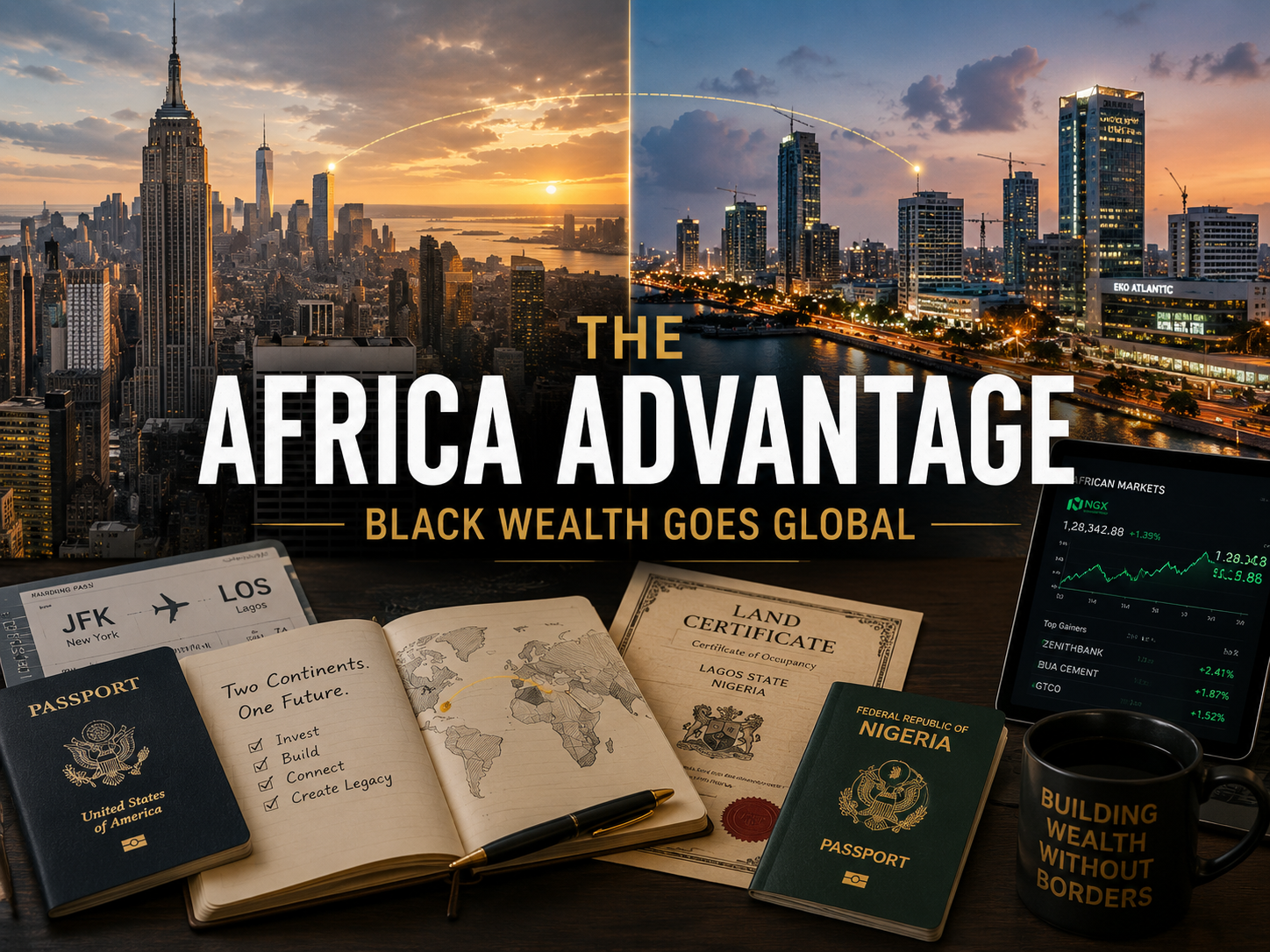
For much of modern history, conversations about Black wealth have been geographically constrained.
The debate has focused on how descendants of Africa can build greater prosperity within the countries where they currently live. In the United States, that conversation has centered on entrepreneurship, homeownership, investing, education, income, and access to capital. These are important topics. They will remain important topics.
Yet beneath many of these discussions sits an assumption that is rarely examined.
The assumption is that the future of Black wealth will be built primarily within the borders of the United States.
For generations, that perspective made sense. Most people build their lives where they live. They work there. Invest there. Raise families there. Build businesses there.
But the twenty-first century is reshaping many long-standing assumptions about geography, identity, and opportunity.
The world is becoming more interconnected. Capital moves globally. Information travels instantly. Remote work has altered traditional definitions of place. International travel is more accessible than it was for previous generations. Technology has reduced the barriers that once separated people from distant markets, communities, and opportunities.
At the same time, Africa is undergoing profound demographic, economic, and technological change.
These two developments are often discussed separately.
Perhaps they should be discussed together.
Because when viewed through the same lens, they reveal a possibility that many descendants of Africa have never seriously considered:
The future of Black wealth may be global.
Looking in One Direction
Every generation inherits assumptions about where opportunity exists.
Sometimes those assumptions are correct.
Sometimes they outlive the conditions that created them.
For much of the twentieth century, opportunity flowed overwhelmingly toward Europe and North America. Economic power, political influence, technological innovation, and access to capital were concentrated in relatively few regions.
As a result, millions of people around the world oriented their ambitions toward those centers of gravity.
That logic was understandable.
People move toward opportunity.
Families seek stability.
Investors pursue growth.
Students pursue education.
Entrepreneurs pursue markets.
The challenge is that mental maps often change more slowly than reality.
A region can begin transforming long before the broader public notices.
By the time everyone recognizes the shift, many of the greatest opportunities have already been claimed.
History offers countless examples.
Few people wanted to invest heavily in Silicon Valley when it was still emerging.
Few people recognized the significance of Shenzhen before it became one of the world's most important manufacturing and technology centers.
Economic transformations often appear obvious in retrospect.
They rarely feel obvious while they are happening.
The Importance of Demographics
Economists debate many things.
One area where there is relatively little disagreement is the importance of demographics.
Population trends influence labor markets, consumer demand, housing, entrepreneurship, innovation, and long-term economic growth.
Many developed nations are confronting demographic challenges. Birth rates have declined. Populations are aging. Workforce participation is becoming a growing concern.
Africa presents a very different picture.
The continent is home to the youngest population in the world.
Over the coming decades, hundreds of millions of young people will enter working age across African countries. They will become consumers, entrepreneurs, professionals, investors, engineers, builders, and business owners.
Demographics alone do not guarantee prosperity.
No serious observer would make that claim.
But demographics create potential.
And potential matters.
When investors evaluate future markets, they pay attention to where populations are growing, where cities are expanding, and where economic activity is increasing.
Those trends do not determine the future.
They help shape it.
The Story We Were Told About Africa
For many descendants of Africa living in the West, perceptions of the continent were largely formed through media.
The images were often familiar.
Famine.
Conflict.
Corruption.
Political instability.
Humanitarian crises.
These realities exist.
Ignoring them serves no one.
The problem is not that these stories were false.
The problem is that they were incomplete.
Imagine attempting to understand the United States solely through slavery, Jim Crow, redlining, racial violence, and the long struggle for civil rights.
All of those issues are real.
None of them adequately explain the country.
The same principle applies to Africa.
The continent contains some of the world's fastest-growing urban centers.
It contains thriving technology ecosystems, expanding financial sectors, major infrastructure projects, growing middle classes, and increasingly sophisticated entrepreneurial networks.
These developments rarely receive the same attention as negative headlines.
As a result, many people possess a mental image of Africa that reflects the past more than the present.
And when perception lags behind reality, opportunities often remain hidden.
Wealth Is More Than Money
When people discuss wealth, they often focus on financial assets.
Income.
Investments.
Property.
Businesses.
These are important.
But wealth has always involved more than money.
Identity is wealth.
Lineage is wealth.
Knowing one’s ancestry is wealth.
Throughout history, families created advantages through relationships, networks, trust, cultural fluency, and access to information.
Some of the most powerful forms of wealth never appear on a balance sheet.
A family connected to multiple countries possesses a different set of opportunities than a family connected to only one.
A business owner with relationships across several markets possesses options that others do not.
A person who understands multiple cultures can navigate environments that might feel inaccessible to someone else.
These advantages are difficult to quantify.
Yet they often prove enormously valuable.
This is one reason why identity matters.
Not because identity is merely symbolic.
Because identity influences access.
It influences belonging.
It influences relationships.
It influences the opportunities people can recognize and pursue.
For many descendants of Africa, identity has been framed largely as a story of what was taken rather than a story of what remains. The focus has often been placed on names that were lost, languages that disappeared, families that were separated, and histories that were interrupted. These losses were real and their consequences continue to shape the present. Yet an exclusive focus on loss can obscure another reality. Not everything disappeared. Ancestry remained. Bloodlines remained. Cultural memory remained. In many cases, living relatives remained. Entire nations, communities, traditions, and peoples remained. The question facing the twenty-first century may not simply be what was lost. It may be what can still be recovered.
History matters.
But identity also has a future.
A Different Kind of Inheritance
Much of the Black experience in the Americas has understandably focused on loss.
People lost names.
Languages.
Family connections.
Cultural continuity.
Knowledge of ancestral origins.
These losses were real.
They were the direct result of one of history's greatest crimes.
But an exclusive focus on what was lost can obscure another question.
What remains?
That question deserves serious consideration.
Because modern technology is making forms of reconnection possible that previous generations could scarcely imagine.
DNA testing has transformed genealogy.
Digital archives have made historical records more accessible.
Social media has enabled relationships across continents.
Travel has become dramatically easier than it was only a few decades ago.
For the first time in history, millions of descendants of Africa have tools that make it possible to reconnect with ancestral regions, cultures, communities, and in some cases even living relatives.
This is not simply a genealogical development.
It may prove to be an economic and social development as well.
The implications are only beginning to emerge.
The Two-Continent Perspective
One of the most limiting ideas inherited from the modern nation-state is the belief that identity must fit neatly within a single border.
Reality is often more complicated.
Around the world, millions of people maintain meaningful connections to multiple countries.
They build businesses in one nation while owning property in another.
They maintain family ties across continents.
They invest globally while preserving local roots.
No one finds this unusual.
It is increasingly normal.
Yet many descendants of Africa have not been encouraged to imagine themselves in similar terms.
For some, Africa exists primarily as a historical reference point.
A place connected to ancestry rather than possibility.
A place associated with origins rather than futures.
That distinction matters.
Because the way people imagine themselves often shapes the opportunities they pursue.
A person who sees themselves as connected to only one world will make different decisions than someone who sees themselves as connected to two.
Seeing What Others Miss
The greatest opportunities are often invisible to those who are not looking for them.
This principle applies to investing.
It applies to business.
It applies to entire regions.
Markets become crowded once everyone agrees they are promising.
By then, much of the asymmetrical advantage has disappeared.
The same pattern appears throughout history.
People frequently underestimate emerging regions because they are evaluating them through outdated assumptions.
The challenge is not merely identifying where growth is occurring.
The challenge is recognizing when old narratives no longer match present realities.
That requires intellectual flexibility.
It requires curiosity.
It requires a willingness to question inherited beliefs.
This is particularly important when discussing Africa because many assumptions about the continent were formed by people who had little incentive to highlight its strengths.
Colonial systems benefited from portraying Africa as dependent rather than capable.
Western media often benefits from emphasizing crisis over complexity.
Political narratives frequently reduce entire continents to simplistic stories.
The result is that many descendants of Africa know surprisingly little about a region that may play an increasingly important role in the twenty-first century.
The Africa Advantage
The Africa Advantage is not a guarantee of wealth.
It is not a shortcut.
It is not an investment strategy.
It is a perspective.
It begins with a simple observation.
Millions of descendants of Africa may possess access to relationships, opportunities, identities, and networks that they have never been taught to recognize.
The conversation is not about abandoning America.
It is not about choosing Africa over the West.
It is not about romanticizing one place while dismissing another.
It is about expanding the map.
It is about recognizing that the descendants of a global people may benefit from thinking globally.
The future will belong to those who can operate across cultures, across networks, and across borders.
The ability to navigate multiple worlds may become one of the defining advantages of the century ahead.
For descendants of Africa, that possibility carries unique significance.
Because unlike many people seeking international connections, they are not approaching Africa as strangers.
They are approaching it as descendants.
That distinction does not guarantee opportunity.
But it changes the conversation.
And conversations often shape futures.
Looking Beyond the Horizon
Every generation inherits a set of assumptions about what is possible.
Some assumptions expand opportunity.
Others quietly limit it.
For generations, many descendants of Africa have been taught to think about the continent primarily through the lens of the past.
The next generation may view it differently.
Not only as a place connected to ancestry.
But as a place connected to possibility.
History matters.
Memory matters.
Justice matters.
But the future matters too.
The most important question may not be what was taken.
The most important question may be what can still be built.
And that raises a deeper issue.
If Africa represents an overlooked source of opportunity, connection, and possibility, could it also represent a missing piece of the broader Black wealth conversation?
That is where our exploration goes next.
Related Reading
- What If Africa Is the Missing Piece of the Black Wealth Conversation?
- The New African American Dream: Building Wealth on Two Continents
- Living in America, Building in Africa
- Black Privilege: The Untapped Advantage Hidden in Plain Sight
- The Story of Jon James Omobowale Olomo: From Discovery to Citizenship
Jon James Omobowale Olomo is the founder of Tribal Tapestry. After discovering his Yoruba ancestry through DNA and genealogy, he located living relatives in Nigeria, stood on his ancestral family compound, received formal recognition of his ancestral connection from the King of Imota, became a Nigerian citizen, acquired land in Nigeria, and was later honored with the Yoruba chieftaincy title of Baseto Ipadabo Sile of Ikorodu Kingdom—a title meaning Pathfinder Who Leads One Back to Their Source. He now works to help descendants of Africa reconnect with their heritage, identity, and opportunities across two continents.