


What If Africa Is the Missing Piece of the Black Wealth Conversation?
June 17, 2026
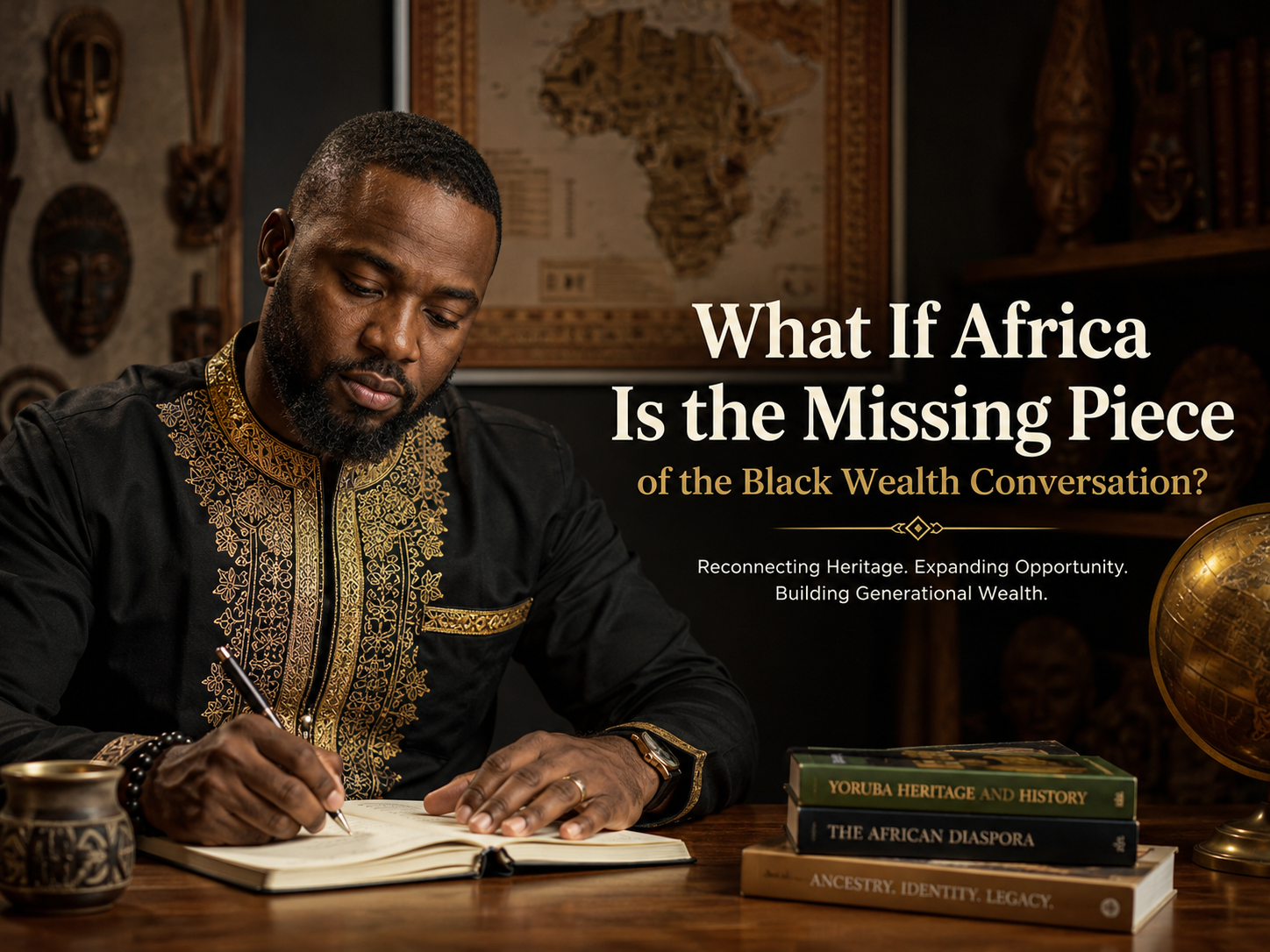
Several years ago, if someone had asked me how Black Americans could build more wealth, my answer would have sounded fairly conventional.
I would have talked about education, entrepreneurship, investing, homeownership, and access to capital. I would have pointed to many of the same solutions that dominate conferences, podcasts, books, and public policy discussions.
What I would not have talked about was Africa.
That omission seems strange to me now.
Not because I believed Africa had nothing to offer. The truth is more revealing. Like many descendants of Africa, I had never seriously considered whether the continent had any meaningful role to play in the future I imagined for myself, my family, or my community.
Africa was connected to ancestry.
It was connected to history.
It was connected to questions about where my family came from.
It was not connected to questions about where my family was going.
That assumption remained largely unchallenged until I began tracing my own lineage.
What started as a search for family history eventually led me to living relatives in Nigeria. It led me to communities that preserved knowledge about my ancestry. It led me to traditional rulers, local families, and cultural institutions that viewed my return not as an act of exploration, but as a form of reconnection.
At one point, I found myself standing on land tied to my ancestral family line. Later, I received formal recognition of that connection through a letter of attestation from the Ranodu of Imota. I eventually became a Nigerian citizen.
Those experiences did not simply change what I knew about my ancestry.
They changed how I think about opportunity.
More importantly, they forced me to confront a question that I had somehow never asked before.
Why is Africa almost entirely absent from conversations about Black wealth?
A Conversation With Invisible Boundaries
For generations, discussions about Black economic advancement have been shaped by the realities of American life.
That focus is understandable.
The struggle for civil rights occurred here. The fight against segregation occurred here. The battles over voting rights, housing, education, and employment occurred here.
When people discuss Black wealth, they are usually responding to conditions they can see directly.
Over time, however, a subtle assumption became embedded within the conversation.
The assumption is that prosperity will be created almost exclusively within the borders of the United States.
Most people never state this outright. It simply operates in the background.
As a result, entire categories of possibility often remain unexplored.
The interesting thing about assumptions is that they become difficult to notice when everyone shares them.
The Question Other Communities Rarely Ask
Imagine telling an entrepreneur from India that India should have no bearing on how they think about future opportunities.
Imagine suggesting to someone from a Chinese, Lebanese, or Jewish family that ancestral connections, international relationships, cultural familiarity, and overseas networks are irrelevant to wealth creation.
Most people would find the idea peculiar.
Throughout the world, communities routinely maintain connections that extend beyond a single country. Families invest across borders. Business owners cultivate relationships in multiple markets. People draw upon cultural, familial, and economic ties that stretch across continents.
This is not considered unusual.
It is considered normal.
Yet descendants of Africa are often encouraged to view Africa differently.
The continent is frequently presented as a place connected to memory rather than possibility.
For many people, Africa occupies a historical category instead of a strategic one.
Once I recognized that distinction, it became difficult to ignore.
The Difference Between Perception and Reality
Before my first trip to Nigeria, most of what I knew about Africa came from the same sources that shape public opinion throughout the West.
News coverage.
Documentaries.
School curricula.
Popular culture.
Some of those portrayals reflected genuine challenges. Corruption exists. Infrastructure challenges exist. Political instability exists in certain places.
But after spending time on the continent, I realized that many of the stories were incomplete.
What rarely appears in headlines are the entrepreneurs building companies, the families creating wealth, the professionals returning home to invest, the rapidly expanding cities, and the communities preparing for a future they believe will look very different from the past.
The gap between the dominant narrative and lived reality was larger than I expected.
That observation is not unique to Africa.
History is full of examples where public perception lagged behind actual conditions.
People tend to notice emerging opportunities only after those opportunities become obvious.
By then, much of the advantage has already disappeared.
Wealth Is Not Only Financial
One reason this topic matters is that wealth has never been limited to money.
Financial capital is important, but it is not the only form of capital that shapes outcomes.
Relationships matter.
Trust matters.
Access matters.
Networks matter.
Families have always used these assets to create opportunities across generations.
Identity can influence all of them.
This is one reason I have become increasingly interested in the practical implications of ancestry.
Most people think of ancestry as a matter of personal history. They view it as something that helps answer questions about who they are.
That is certainly part of its value.
But ancestry can also reveal connections that extend into the present. It can create relationships, open conversations, and establish forms of belonging that would otherwise remain invisible.
I did not expect my own search for ancestry to alter the way I thought about economics, citizenship, investment, or opportunity.
Yet it did.
Not because DNA creates wealth.
Because identity can create access.
And access often changes what becomes possible.
Looking Beyond Loss
The history of the African diaspora is often told through the lens of separation.
For obvious reasons.
Families were divided.
Languages disappeared.
Knowledge was interrupted.
Entire histories became difficult to recover.
Those realities deserve acknowledgment.
At the same time, I have come to believe that the conversation becomes incomplete when it focuses exclusively on what was lost.
During my own journey, I encountered something that receives far less attention.
I discovered what remained.
Communities remained.
Cultures remained.
Family connections remained.
Traditional institutions remained.
Entire nations remained.
In many cases, opportunities remained as well.
This does not erase the losses.
It simply broadens the conversation.
Expanding the Frame
The purpose of this argument is not to suggest that African Americans should abandon America or transfer their hopes to another continent.
The issue is not choosing one place over another.
The issue is whether the framework we use to discuss Black wealth has become too narrow.
When I look at the conversations taking place today, I often see people debating how to obtain a larger share of opportunities that already exist within the American system.
That conversation remains important.
What I see far less often is a discussion about expanding the field of opportunity itself.
The world is becoming increasingly interconnected.
Capital is global.
Business is global.
Relationships are global.
The descendants of Africa are global.
It seems reasonable to ask whether our wealth conversation should reflect that reality.
The Missing Piece
After tracing my ancestry, locating relatives, becoming a citizen, acquiring land, and building relationships on both sides of the Atlantic, I arrived at a conclusion I did not expect when this journey began.
Africa is not simply relevant to questions about where many of us came from.
It may also be relevant to questions about where many of us are going.
That does not mean every opportunity will be found there.
It does not mean everyone will choose to engage with the continent in the same way.
It does mean that an entire dimension of possibility has been largely absent from one of the most important conversations in our community.
For decades, Black wealth discussions have focused primarily on navigating systems that already exist.
Perhaps the next stage of the conversation involves recognizing opportunities that have been overlooked.
If Africa represents a source of connection, belonging, relationship, and opportunity that many descendants of Africa have barely begun to explore, then the question is no longer whether the continent matters.
The more interesting question is why it took so long for it to enter the conversation at all.
Related Reading
- The Africa Advantage: Why the Future of Black Wealth May Be Global
- The New African American Dream: Building Wealth on Two Continents
- Living in America, Building in Africa
- Black Privilege: The Untapped Advantage Hidden in Plain Sight
- The Story of Jon James Omobowale Olomo: From Discovery to Citizenship
Jon James Omobowale Olomo is the founder of Tribal Tapestry. After discovering his Yoruba ancestry through DNA and genealogy, he located living relatives in Nigeria, stood on his ancestral family compound, received formal recognition of his ancestral connection from the King of Imota, became a Nigerian citizen, acquired land in Nigeria, and was later honored with the Yoruba chieftaincy title of Baseto Ipadabo Sile of Ikorodu Kingdom—a title meaning Pathfinder Who Leads One Back to Their Source. He now works to help descendants of Africa reconnect with their heritage, identity, and opportunities across two continents.